React vs Angular for Enterprise Apps
Modern enterprises need web applications that are fast, scalable, secure, and easy to maintain. Two of the most popular JavaScript technologies powering these applications are React and Angular. Both have proven themselves in enterprise environments, but they serve different development approaches and business requirements.
Choosing between these technologies is not simply about popularity—it’s about selecting the right framework for your project’s complexity, scalability goals, and long-term maintenance strategy.
In this guide, we’ll compare React and Angular for enterprise applications, explore their strengths, and help businesses understand when each technology makes the most sense.
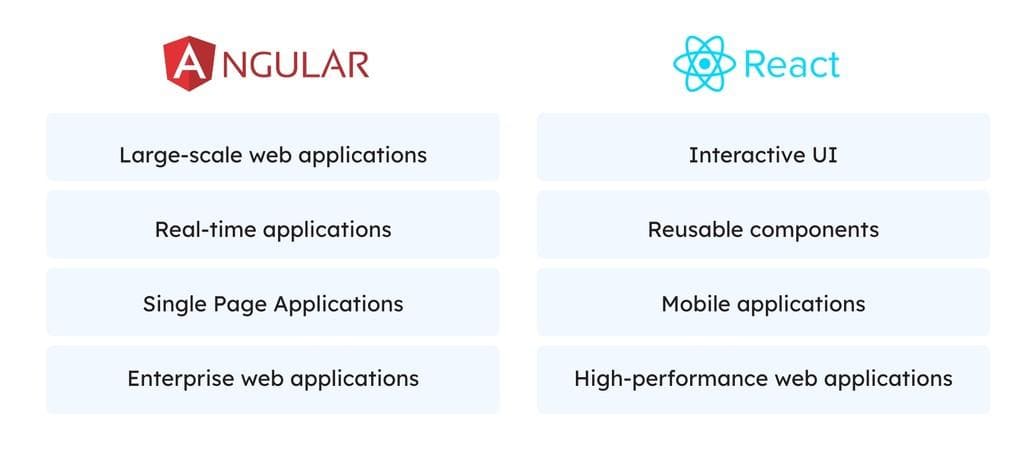
Why React and Angular Dominate Enterprise Development
Large organizations require applications that can handle thousands of users, integrate with multiple systems, and evolve over time. Both React and Angular provide mature ecosystems that support these requirements.
Businesses investing in Web Development often evaluate both technologies because they offer:
- Strong developer communities
- Long-term ecosystem support
- Enterprise-ready architecture
- Extensive third-party integrations
- Modern development tools
The best choice depends on the type of application you’re building rather than one technology being universally better.
React at a Glance
React is a JavaScript library designed for building user interfaces. It focuses primarily on the presentation layer while allowing developers to choose additional libraries for routing, state management, and other functionality.
React strengths include:
- Faster UI rendering
- Component-based architecture
- Flexible project structure
- Large developer community
- Strong ecosystem for modern applications
Many businesses choose React Web Application Development when creating customer-facing platforms that require interactive and responsive interfaces.
Angular at a Glance
Angular is a complete front-end framework that includes built-in tools for routing, forms, dependency injection, and testing.
Its structured approach makes it particularly suitable for large-scale enterprise applications where consistency across development teams is essential.
Angular strengths include:
- Complete development framework
- Built-in enterprise features
- TypeScript-first architecture
- Strong scalability
- Consistent coding standards
Companies often choose Angular Development Services for complex internal business applications and enterprise portals.
React vs Angular: Key Differences
| Feature | React | Angular |
| Type | JavaScript Library | Full Framework |
| Language | JavaScript / TypeScript | TypeScript |
| Learning Curve | Easier | Steeper |
| Flexibility | High | Structured |
| Performance | Excellent UI performance | Excellent enterprise performance |
| Built-in Features | Minimal | Extensive |
| Best For | Dynamic web apps | Large enterprise systems |
Rather than declaring one framework superior, businesses should evaluate which approach aligns with their project requirements.
Performance Comparison
Both technologies deliver strong performance, but they optimize it differently.
React Performance
React uses a Virtual DOM to efficiently update only the parts of the interface that have changed.
This makes it well-suited for:
- Interactive dashboards
- Social platforms
- eCommerce websites
- Customer portals
Angular Performance
Angular includes built-in optimization features while using advanced rendering techniques and TypeScript to support large enterprise applications.
Its architecture performs particularly well when applications have:
- Complex business logic
- Large development teams
- Long-term maintenance requirements
Scalability for Enterprise Applications
Scalability is often one of the key factors in the decision-making process.
React Scalability
React offers flexibility, allowing teams to build scalable architectures using libraries like Redux, React Router, and other ecosystem tools.
This flexibility benefits organizations that want customized development workflows.
Angular Scalability
Angular provides standardized project organization from the beginning.
This consistency helps:
- Large development teams
- Enterprise governance
- Long-term code maintenance
- Standardized architecture
For organizations with multiple development teams, Angular’s structured approach can simplify collaboration.
Development Experience
Developer productivity directly affects project timelines.
React Development Experience
React developers often appreciate:
- Faster component creation
- Reusable UI components
- Flexible architecture
- Large open-source ecosystem
Businesses looking for rapid product launches frequently choose React Web Application Development for these advantages.
Angular Development Experience
Angular emphasizes organization.
Developers benefit from:
- Built-in testing support
- Dependency injection
- Strong TypeScript integration
- Consistent coding patterns
These features reduce complexity in larger projects.
Security Considerations
Enterprise applications must protect sensitive business data.
React Security
React includes protections against common vulnerabilities, but developers remain responsible for implementing secure authentication, authorization, and API protection.
Angular Security
Angular includes several built-in security features, including:
- Sanitization
- Protection against XSS attacks
- Secure template handling
These built-in capabilities make security implementation more streamlined for enterprise teams.
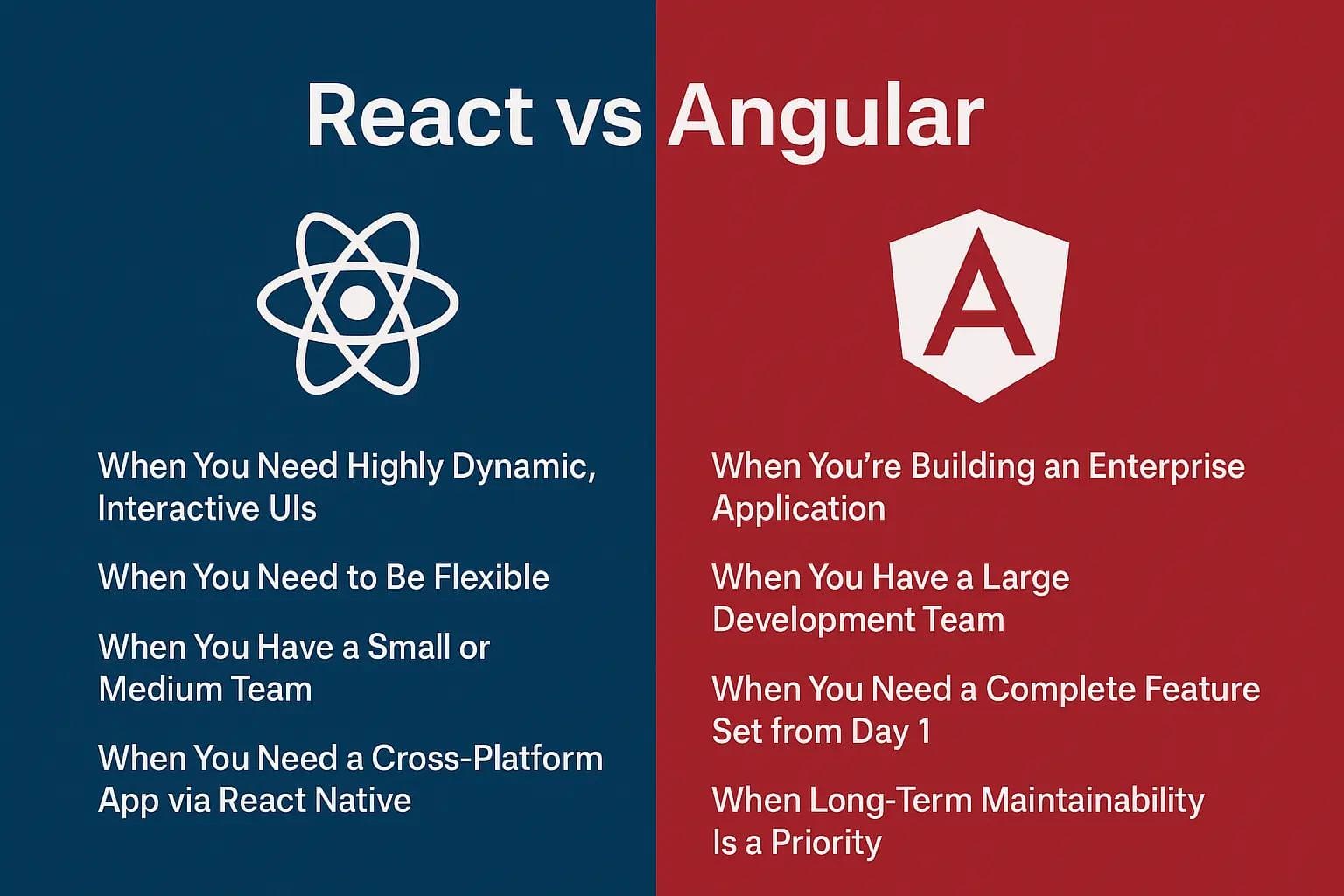
When Should You Choose React?
React is often a strong fit when your project requires:
- Highly interactive interfaces
- Fast product development
- Flexible architecture
- Modern web applications
- Excellent user experience
Many startups and digital products benefit from React’s rapid development capabilities.
When Should You Choose Angular?
Angular becomes particularly valuable for:
- Enterprise business software
- Large internal platforms
- Long-term maintenance
- Multiple developer teams
- Complex workflows
Organizations building large-scale business systems frequently prefer Angular’s structured development model.
How Omex Infotech Helps Businesses Choose the Right Framework
At Omex Infotech, we help businesses evaluate project requirements before selecting the most suitable technology.
Our expertise includes:
- Web Development
- React Web Application Development
- Angular Development Services
- Enterprise software architecture
- Scalable application development
Rather than recommending a one-size-fits-all solution, our team builds applications that align with business goals, performance requirements, and future growth.
Final Thoughts
The React vs Angular for Enterprise Apps debate has no universal winner because each technology excels in different scenarios. React provides exceptional flexibility and fast UI development, while Angular offers a complete framework designed for large enterprise environments.
The right decision depends on your application’s complexity, team structure, scalability requirements, and long-term maintenance goals. With experienced developers and the right development strategy, either technology can power secure, scalable, and high-performing enterprise applications. Contact OMEX Infotech
FAQs
React is a JavaScript library for building user interfaces, while Angular is a complete front-end framework with built-in enterprise features.
Both are suitable for enterprise applications. React offers flexibility, while Angular provides a structured framework for large-scale projects.
React’s Virtual DOM helps deliver fast UI updates, while Angular offers strong performance for complex enterprise applications through its optimized framework architecture.
Yes. Angular is built around TypeScript, which improves code organization and scalability.
Businesses should consider React for interactive user interfaces, customer-facing platforms, and projects requiring rapid development.
Angular Development Services are commonly used for enterprise portals, internal business applications, dashboards, and large-scale software systems.
React generally has a shorter learning curve, while Angular requires developers to learn more built-in concepts.
Both scale well, but Angular’s structured architecture often benefits larger development teams working on complex enterprise systems.
Yes, when developers implement proper authentication, authorization, and secure coding practices.
Omex Infotech provides experienced developers, enterprise-focused Web Development expertise, and customized solutions using both React and Angular technologies.